
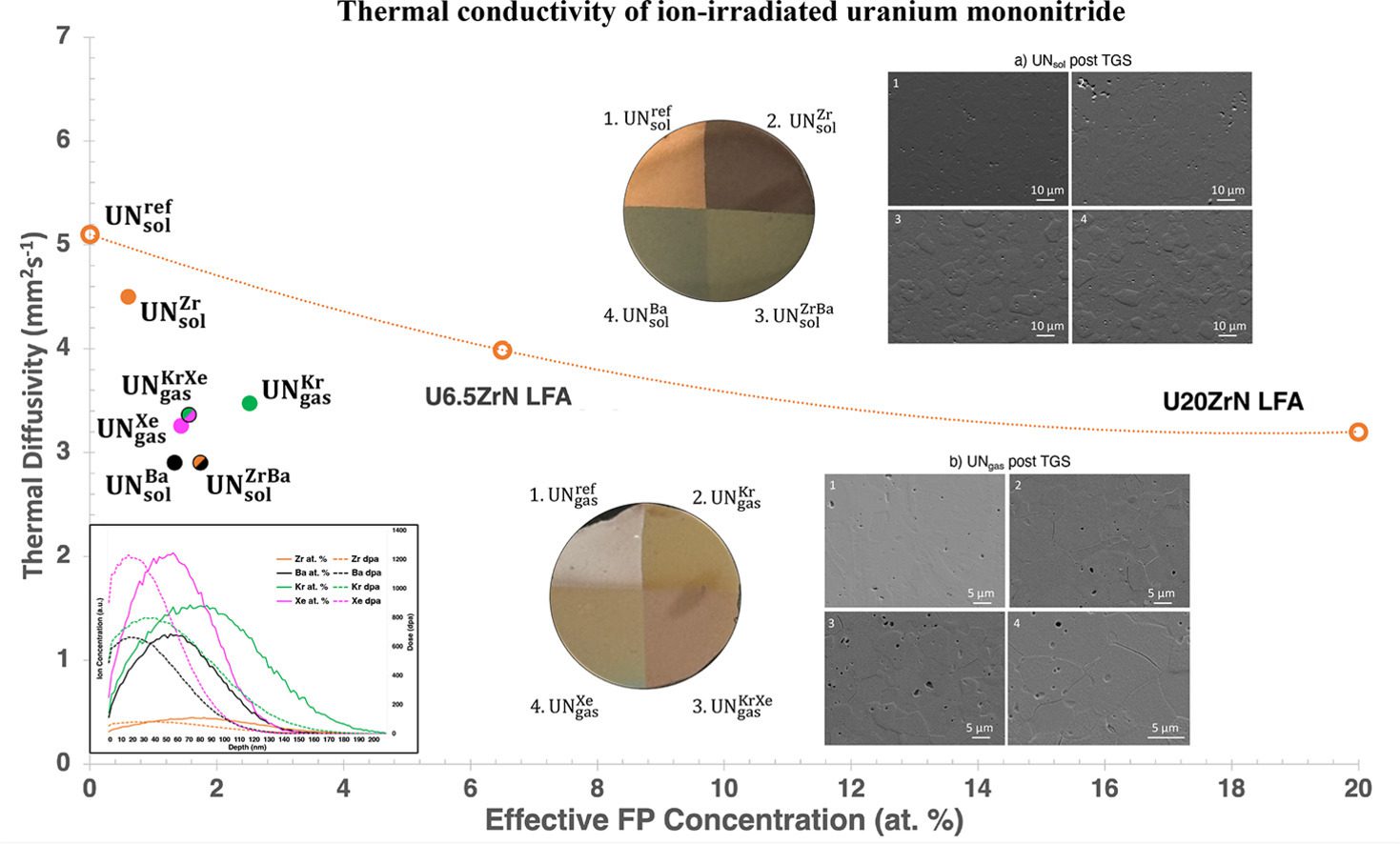




Thermal diffusivity of ion-irradiated uranium mononitride
Abstract
Uranium mononitride is a candidate fuel for advanced fast reactors due to its high fissile density and high thermal conductivity. However, its thermophysical property changes due to both chemical impurities and irradiation-induced damage, have not been extensively studied. In this work, we investigate the effect of selected fission product species on the thermal properties of UN using ion implantation. Dense UN pellets were implanted with elements representative of solid (Zr, Ba) and gaseous (Kr, Xe) fission products at different fluences. Near-surface chemistry, morphology and microstructure were characterised using scanning electron microscopy and time-of-flight elastic recoil detection analysis. Thermal diffusivity was measured using transient grating spectroscopy, probing the top ∼1 μm of the implanted regions, for temperatures up to 670 K. For solid fission product implantation, the thermal diffusivity decreases relative to unimplanted UN and remains stable with temperature, consistent with impurity scattering and implantation-induced damage. In contrast, gaseous fission product implantation leads to a stronger and largely irreversible reduction in diffusivity. Heating and cooling measurements reveal pronounced hysteresis, accompanied by grain-boundary cracking and enhanced surface oxidation after thermal cycling. These observations suggest redistribution and partial release of Kr and Xe to grain boundaries and defects, leading to microstructural degradation that suppresses heat transport. The results highlight clear differences between solid and gaseous fission product effects on thermal properties in uranium mononitride. Additionally, irradiation damage was observed to be the primary contributor to the degradation of thermal diffusivity, while chemical effects are secondary. Lastly, the work demonstrates the usefulness of combining ion implantation and transient grating spectroscopy to study thermophysical behaviour of nuclear fuels, and the capability to separate chemical effects from implanted damage in the degradation of thermal transport.
Article: 10.1016/j.jnucmat.2026.157121